Research · ETH Zurich · Molecular Design Lab · 2021
De Novo Drug Design from Protein Pockets
Reading a protein pocket in 3D and writing a molecule that fits.
- 3D inatoms of the protein pocket as a point cloud
- SMILES outvalid, unique and novel molecules sampled
Semester thesis in Prof. Gisbert Schneider's Molecular Design Lab at ETH Zurich. Euclidean neural networks encode a 3D binding pocket and a language model writes new candidate molecules.
The problem
De novo drug design means generating new compounds from scratch for a given protein target. Deep generative models had become good at writing molecules as text, but most models that read 3D structure were only invariant to translation. Rotate the protein and they see a different input, which makes no chemical sense.
The approach
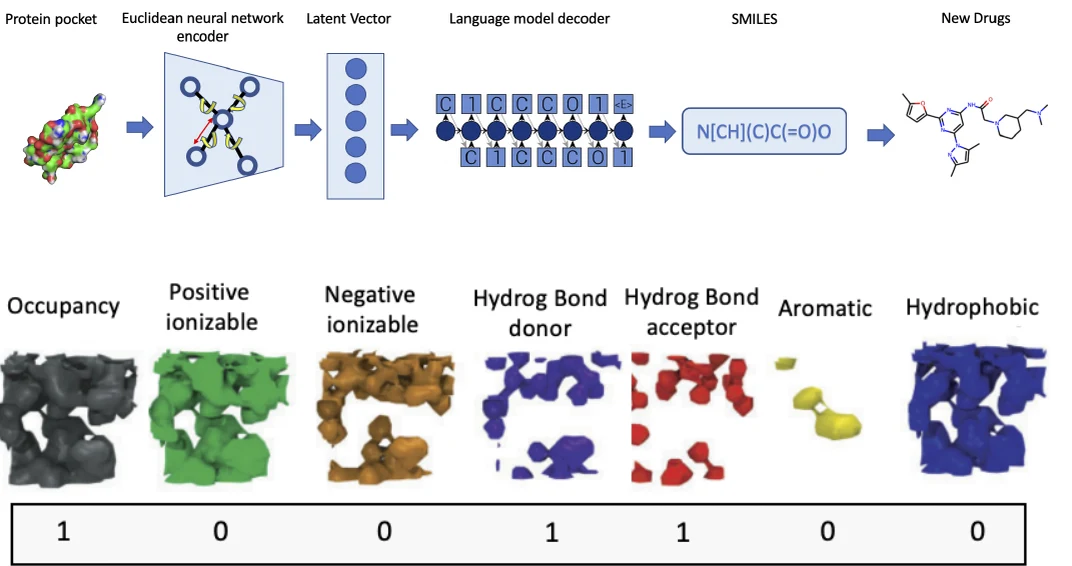
Treat the protein pocket and its ligand as clouds of 3D points, the way computer vision treats a scan.
- Encoder. A Euclidean neural network, built on e3nn and extended for this task, takes atom coordinates and features and produces a representation that does not depend on how the pocket is rotated.
- Decoder. An LSTM with attention learns the grammar of SMILES and writes the ligand one token at a time, like a captioning model describing an image.
Result
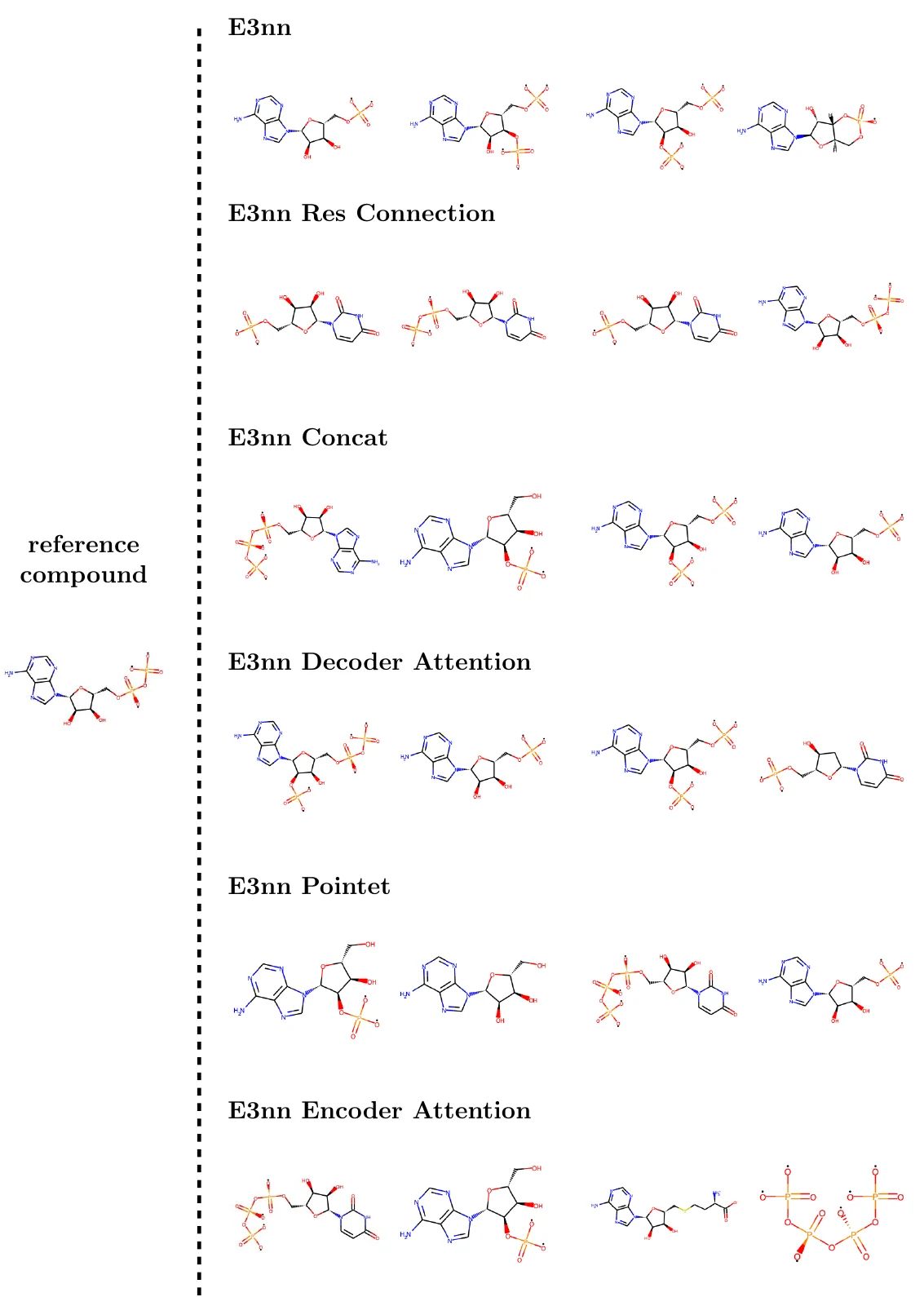
Sampling from the latent space defined by a reference pocket produced a broad set of valid, unique and novel molecules, demonstrating that Euclidean neural networks can generate SMILES conditioned on a binding pocket. Attention maps showed which parts of the pocket drove each generated token.
Supervised by Dr. Jose Jimenez Luna and Prof. Gisbert Schneider.
Figures